What GAO Found
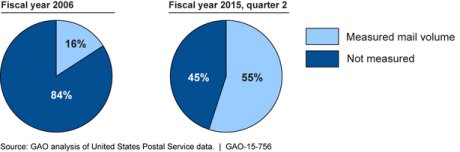
U.S. Postal Service (USPS) measurement of on-time delivery performance has expanded greatly over the past 9 years, but remains incomplete because only 55 percent of market-dominant mail (primarily First-Class Mail, Standard Mail, Periodicals, and Package Services) is included (see fig.). The remaining 45 percent is excluded due to various limitations, such as not having barcodes to enable tracking. Incomplete measurement poses the risk that measures of on-time performance are not representative, since performance may differ for mail included in the  measurement, from mail that is not. Complete performance information enables effective management, oversight, and accountability. In addition, the Postal Regulatory Commission (PRC) has not fully assessed why USPS data are not complete and representative. While PRC’s annual reports have provided data on the amount of mail included in measurement, they have not fully assessed why this measurement was incomplete or whether USPS actions will make it so. PRC may initiate a public inquiry docket (a type of proceeding) to improve data quality and completeness, but has not done so. Such a proceeding could facilitate evaluating data quality and identifying areas for improvement, as well as actions and time frames to complete improvements.
Mail Included in Performance Measurement, Fiscal Year 2006 and Second Quarter of Fiscal Year 2015
USPS’s and PRC’s reports on delivery performance are not as useful as they could be for effective oversight because they do not include sufficient analysis to hold USPS accountable for meeting its statutory mission to provide service in all areas of the nation. USPS’s and PRC’s reports provide analysis, as legally required. However, this national-level analysis does not facilitate an understanding of results and trends below the national level, such as for USPS’s 67 districts, to identify variations and areas where improvements are needed. Further, delivery performance information is not sufficiently transparent or readily available. USPS posts only the most recent quarterly report on its website making it difficult for stakeholders to access trend data. Also, USPS and PRC are not required to provide—and do not report—performance information for rural areas. While several Members of Congress have recently requested studies on rural delivery performance, USPS has stated that such analysis would be costly, even though it could not provide specific cost estimates. Such cost information would be useful for Congress to assess whether developing this information would be appropriate.
Why GAO Did This Study
USPS is in the difficult position of balancing cost-cutting actions to address its poor financial situation with efforts to provide prompt, affordable, and reliable mail service. GAO has previously reported that complete, useful, and transparent delivery performance information is essential for USPS and stakeholders to understand USPS’s success in achieving this balance.
GAO was asked to review how USPS measures delivery performance and how PRC assesses this information. GAO assessed (1) USPS’s measurement of mail delivery performance and related oversight by PRC and (2) USPS’s and PRC’s reporting of this information. GAO reviewed USPS and PRC delivery performance data for fiscal years 2010-2015, delivery service standards, and measurement system documents, as well as applicable laws and leading practices identified in GAO’s prior work.
What GAO Recommends
To assist in determining whether to require USPS and PRC to report on delivery performance for rural areas, Congress should direct USPS to provide cost estimates related to providing this information. Further, GAO recommends that USPS and PRC take steps to improve the completeness, analysis, and transparency of delivery performance information. USPS and PRC agreed with the recommendations addressed to them, but disagreed with certain findings on which they are based. GAO believes these findings are valid, as discussed in this report.
For more information, contact Lori Rectanus at (202) 512-2834 or rectanusl@gao.gov.