Race to the top
Battle for excellence continues as districts and areas swap rankings
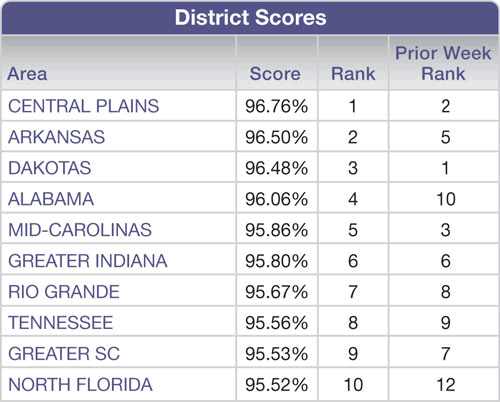
National end-to-end scanning results remained strong during the week ending July 13, with a performance score of almost 94 percent.
At the area level, Southern maintained its first-place spot with a score of 94.7 percent. Capital Metro jumped from fourth to second with a score of 94.4 percent. Great Lakes, Western and Eastern rounded out the top five, respectively.
In the nation’s districts, Central Plains climbed from second to first place with a score of 96.8 percent. Arkansas leaped from fifth to second place, posting a score of 96.5 percent. Alabama charged up the rankings from tenth place to fourth with a score of 96 percent.
Standings in the ZIP-3 areas underwent significant changes. Aberdeen, SD (574) continued its hold on first place with a performance rating of 99.4 percent. Salina, KS (669), moved from tenth to second place with a score of 98.5 percent. In third place, Culpeper, VA (227), soared from a rank of 82 in the previous week with a performance rating of 98.5 percent.
Performance scores and standings change regularly. Readers with EDW eAccess approval can go to the Operations home page to view a dashboard with the latest performance scores. Note: the website is available only to readers using postal computers or BlackBerries)
Scanning improvement activities fall under the corporate “Product Visibility” initiative — one of more than 30 that make up the Delivering Results, Innovation, Value and Efficiency (DRIVE) program. For more information, go to the DRIVE website on Blue. (Note: the website is available only to readers using postal computers or BlackBerries).
I probably have an average of 30 scanable parcels per day, so two missing scans would create a score of roughly 94 percent. There are several reasons this could happen, all of which could be addressed by the Postal Service, with much improvement made.
We accept customer-printed address labels with bar codes that are barely readable, or not readable, due to low ink. They may have to be entered manually.
We accept labels that are placed on parcel creases, which crinkles the bar code and makes it necessary to enter manually.
We accept labels on round or rounded parcels that are placed in such a manner that the scanner cannot “read around” the bar code, again making it necessary for a manual entry.
The ink on some of these bar codes smears when struck by another parcel, or the label is torn in such a way that the bar code AND the number are totally unreadable. These cannot even be entered manually.
I try to manually enter what I can, but it takes TIME, something that is ahem, frowned upon, and carriers often get disgusted wasting time trying to scan a bar code, and after a minute or so, give up, not wasting another minute with manual entry.
Acceptance of poorly printed and poorly placed labels should be addressed,
since we are judged, internally and externally, on scan percentages!
That would leave label damage, which is usually our fault, and again, often an issue of “no time to handle the parcel with more care”.
Another issue is we have to scan our parcels “to the route” while we are loading our vehicles. “Misthrows” often are simply not scanned to the route, and “taken for a ride” because we simply are not given time to go back into the building and put the parcels back into sorting. If the clerks are through sorting, or the correct route has already left for the street, then the parcels sit there another day. This is an internal time disallowance problem, no matter how the supervisors spin it.
Since scanning scores are so important, so competitive, and so necessary to our credibility and service, I think we could easily get scores up to a consistent 98 or 99 percent if these issues would simply improve.