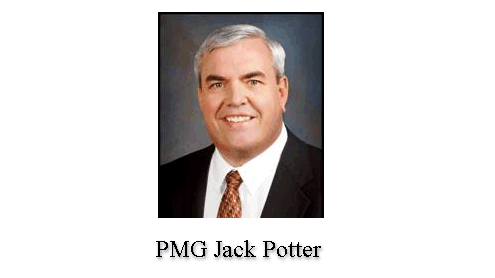
USPS Seeks Flexibility on Operations, Delivery; Possible 2011 Price Increase
WASHINGTON — Facing unprecedented volume declines and a projected, cumulative $238 billion shortfall during the next decade, Postmaster General John E. Potter today outlined an aggressive plan of cost cutting, increased productivity, and an array of legislative and regulatory changes necessary to maintain a viable United States Postal Service.
“The crisis we’re facing gives us an historic opportunity to make changes that will lay the foundation for a leaner, more market responsive Postal Service that can thrive far into the future,” Potter said, stressing that there is no one single answer or quick fix to the crisis.
The Postal Service examined revenue, volume and consumer trends; analyzed revenue and product opportunities employed by foreign posts; and examined more than 50 possible actions to realistically address volume declines that will not return, increasing health care and delivery costs, and dramatic changes to consumer behavior.
“The future depends on a suite of solutions that takes a balanced and reasonable approach, one that cuts across every aspect of our industry but one that, in the end, does the greatest possible good for our stakeholders and the American public,” Potter said.
Mail volume is projected to fall from 177 billion in 2009 to 150 billion in 2020. That represents a 37 percent decline in First-Class Mail alone. Revenue contributed by First-Class Mail will plummet from 51 percent today to about 35 percent in 2020.
“Ensuring a Viable Postal Service for America,” the Postal Service business plan, addresses these challenges, and describes a flexible, agile Postal Service that can adapt to America’s changing mailing habits and preferences.
If the Postal Service takes no action, it will face a cumulative shortfall of $238 billion by 2020. But Potter outlined a number of actions that could amount to as much as $123 billion in savings during that same time period. These actions build on the Postal Service’s record of saving more than $1 billion every year since 2001 and include continuing to aggressively control costs and eliminating hundreds of millions of work hours.
Despite these efforts, an estimated $115 billion shortfall will remain. The business plan identifies actions to close that gap:
- Restructure retiree health benefits payments to be consistent with what is used by the rest of the federal government and the majority of the private sector and address overpayments to the Postal Service Civil Service Retirement System pension fund.
- Adjust delivery days to better reflect current mail volumes and customer habits.
- Continue to modernize customer access by providing services at locations that are more convenient to customers, such as grocery stores, pharmacies, retail centers, and office supply stores. Increase and enhance customer access through partnerships, self-service kiosks and a world-class Website.
- Establish a more flexible workforce that is better positioned to respond to changing demand patterns, as more than 300,000 employees become eligible to retire in the coming decade.
- Ensure that prices of Market Dominant mailing products are based on demand for each individual product and its costs, rather than capping prices for every class at the rate of inflation.
- A modest exigent price increase will be proposed, effective in 2011.
- Permit the Postal Service to evaluate and introduce more new products consistent with its mission, allowing it to better respond to changing customer needs and compete more effectively in the marketplace.
“Lifestyles and ways of doing business have changed dramatically in the last 40 years, but some of the laws that govern the Postal Service have not. These laws need to be modernized to reflect today’s economic and business challenges and the dramatic impact the Internet has had on American life,” Potter said.
The business plan is a path to the future, the Postmaster General said, a future where the Postal Service remains a vital driver of the American economy, an integral part of every American community and continues to deliver the greatest value of any comparable post in the world.
“If given the flexibility to respond to an evolving marketplace, the Postal service will continue to be an integral part of the fabric of American life,” Potter said.
For more information, fact sheets, soundbites and graphics, please visit:
http://www.usps.com/communications/newsroom/2010/pr10_018.htm
There is “DEAD WEIGHT” in every aspect of the postal service. In fact… there is dead weight in the very fabric of the American workforce. The unions protect dead weight, all for the sake of numbers. This dead weight moves on to become the managers of today. Some…. not all. But nepotism, favoritism, etc etc… it all plays a part. Look at what the former cook county board president did in Illinois. Think of that entity as a corporation. Same useless dead weight. Created jobs and cronyism ran ramped. Let’s target the dead weight employees. No matter where or what level they are. Top down shakeup. Loosen the grip of the unions to hold on to this spillage. Reward employees who perform and produce with job security and accolades. Not this stupid status quo of reward by longevity…. only. The seniority formula should be abolished as anything other than simply logging when a person started employment. But definitely NOT a determining factor for ALL benefits and status… regardless of performance or productivity. What a thrill kill. Why bother to join a union. We need Top down cleaning in America.
I for only one, am sick and tired of being forced to work 6 days a week, with forced overtime most days. HELLO MANAGEMENT, ANYONE THERE???
10 hour days of course.
How about Delivery on Monday, Tuesday, and Thursday, Friday?
You want to fix the problem, Get rid of Potter !!!!!!
What Potter has refused to mention is the fact that the postal management is still way too top heavy. There are thousands of upper and middle management positions nationwide that could be eliminated with no threat to a delay in delivering the mail. These overpaid and underworked EAS employees got these jobs, many of which were created for them, by having family members or friends in management in the first place. The executive team should be cut down to almost nothing.