NAPS talking points regarding plant closings for Members of Congress during recess.
October 2014
ISSUE: The U.S. Postal Service is preparing to consolidate 82 mail processing facilities located in 37 states, beginning in January 2015. The USPS plan will eliminate overnight First Class mail service and slow down the nation’s mail throughout the country. Rural areas will be especially hard hit. This reduction in service quality will harm businesses and households, dismantle the mail processing and transportation network, and degrade customer loyalty for the Postal Service and its brand. 
SOLUTION: Congress can prevent this deterioration in mail service quality by requiring the Postal Service to defer the consolidation of these 82 mail processing facilities to permit Congressional work on comprehensive postal reforms to conclude. A majority of Senators and a significant number of House Members favor the preservation of USPS mail standards and the inclusion of a one-year moratorium on mail processing facility consolidations in the FY 2015 omnibus funding measure or CR.
Background
The USPS mail processing facility consolidation initiative constitutes Phase 2 of the “Network Rationalization Plan” the Postal Service announced in 2012; consolidations of 141 processing facilities occurred in 2012 under Phase 1.
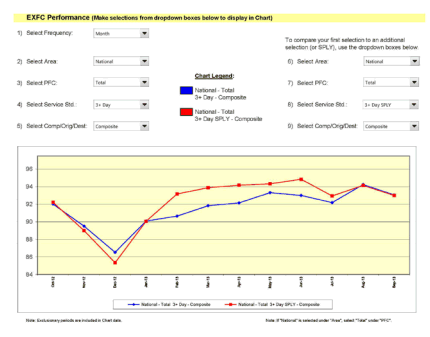
Since that time, mail service quality has eroded as a result of the Phase 1 consolidations, despite the Postal Service’s claims that service is at an all-time high. Steady declines in mail service quality have occurred in the Overnight and 3-5 day markets. The charts below demonstrate the service decline throughout the country.
Because of the consolidations, the Postal Service is delivering mail later and later into the day, and in some locations even into the evening hours, creating customer dissatisfaction and subjecting mail carriers to unsafe conditions.
Printers and commercial mailers are becoming increasingly frustrated by these delays, and are likely to become even more frustrated over further reductions in service. This is likely to erode customer loyalty to USPS and generate interest in alternate delivery methods through USPS competitors.
USPS acknowledges that overnight mail service will worsen as a result of the consolidations. USPS Chief Operating Officer Megan Brennan advised the National Postal Customer Council in early September that, consolidations will make overnight delivery unavailable to at least one-third of current First-Class mail.
Overnight service will remain available, Brennan said, but only for commercial mail that is “properly prepared, containerized and entered by critical entry time.”*
Rural areas throughout the country are especially harmed by these consolidations, due to the longer distances mail will need to be transported. Longer distances also will increase USPS fuel consumption and costs, adversely impacting the environment.
Will these consolidations save money? Take a look at the Postal Service’s fuzzy math. The USPS continues to claim significant savings from these consolidations – as much as $750 million annually — yet has provided little verifying data on the savings to Congress or the public. The Postal Regulatory Commission in 2012 issued an advisory opinion on the financial savings and soundness of the Postal Service’s mail consolidation plan, prior to implementation of Phase 1. The Commission calculated savings from consolidation to be as low as $46 million nationally, compared to the $2.1 billion that USPS originally claimed, and the PRC cited concerns over USPS
methodology and analysis of savings and the impact on service standards.
Meanwhile, the Postal Service shows signs of increasing profitability, especially through expanding ecommerce package delivery. These improvements in the Postal Service’s financial picture call into question the need for cost savings (and service cuts) of the scale planned by the Postal Service. In fact, the Postal Service would have earned a net profit in 2013, but for the statutory burden imposed by Congress in 2006 to
annually prepay approximately $5.5 billion each year in future retiree health benefits. The modification of the prefunding burden represents one of several actions Congress must undertake as part of comprehensive postal reform, either later this year or in 2015.
WHAT CONGRESS CAN DO NOW: Congress should preserve mail service quality by requiring the Postal Service to defer the consolidation of these 82 mail processing facilities through including a provision in the FY 2015 omnibus funding measure or a CR that preserves USPS mail standards and establishes one-year moratorium on consolidations, while Congressional efforts to approve a comprehensive set of postal
reforms continue.
October 1, 2014
* “Critical entry times” are the critical element that USPS relies on to implement the service cutbacks. They are the latest time that a minimal amount of mail can be tendered to designated induction points in the postal network to assure it is processed and dispatched. Reductions in processing capacity and increases in transportation distances necessitate earlier and earlier critical entry times. Even as early as 8:00 am the day prior to delivery, in order to satisfy even a more relaxed mail service standard.
MAIL SERVICE QUALITY ERODES AS CONSOLIDATIONS UNFOLD
Steady declines in mail service quality have occurred in the Overnight and 3-5 delivery day markets, as reflected in the three charts below. They portray single-piece service from the start of the Network Rationalization Plan in 2012 through 2013. The blue line reflects FY 13 delivery quality, while the red line shows quality a year earlier.
EXFC Overnight Goal – 96.80

EXFC 2-Day Goal – 95.50

EXFC 3-5 Day Goal – 95.25